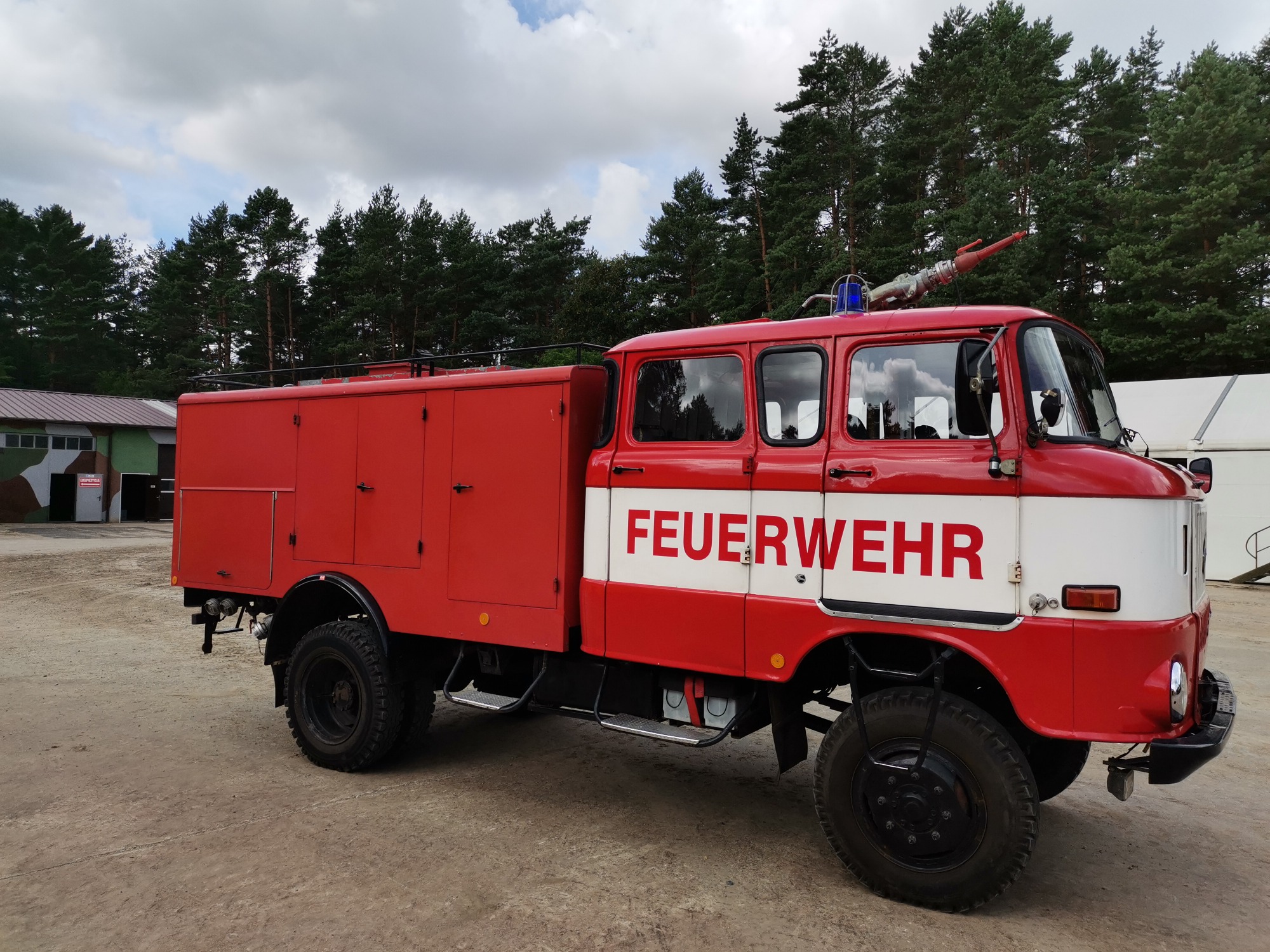

In the late 1950s, work began at the Ernst Grube factory in Werdau on the construction of the now rather anachronistic IFA S4000-1 truck. In 1961, a prototype designated W45 was built, which was very close to the final W50 model. Unlike its predecessor, the new generation of trucks had a wagon cab located above the front axle. To enable large-scale production of the new vehicle, the GDR authorities decided to build an entirely new factory in Ludwigsfelde, south of Berlin. On July 1, 1965, production of the W50 truck began at the newly built VEB IFA plant. By the end of the year, 855 vehicles had left the factory. The standard W50L model was equipped with 4×2 drive, but the W50LA with 4×4 drive quickly entered production, primarily for the military, construction, firefighting, and energy sectors. For agriculture, the W50LA/Z version was created with 4×4 drive and a power take-off for harvesting machinery. The agricultural IFA was equipped with thicker, single tires. For long-distance transport, a version with a longer sleeper cab was developed, while crew cabs were produced for firefighting and energy services. The IFA W50 was powered by a four-cylinder 6.6-liter diesel engine with 110 hp, whose power was increased to 125 hp in 1967. W50 trucks were produced in 60 variants and 240 versions. They were exported to countries such as Czechoslovakia, Romania, Poland, Hungary, Vietnam, Mozambique, and Iraq. Versions sent to Africa were equipped with more robust bumpers and steel cargo boxes. In 1987, a modernized L60 version appeared, featuring a tilting cab and a 9.2-liter, 180 hp six-cylinder engine. In August 1990, production of the L60 ended with 20,289 units. On December 17, 1990, production of the W50 ended with 571,789 units. The Ludwigsfelde plant is currently owned by Mercedes-Benz Trucks.
Engine: Inline 4 6.6L 125 HP
Transmission: 5-speed manual
Drivetrain: AWD (all-wheel drive)