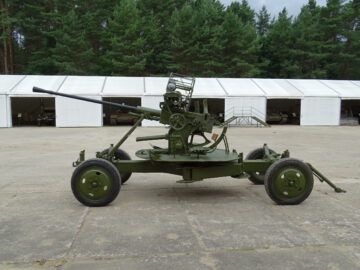

Due to its excellent ballistic characteristics, the barrel of this anti-aircraft gun became the basis for the development of tank guns of the same caliber, including the ZiS-S-53, later used in T-34-85 tanks.
A multipurpose gun, designed for front-line protection, as well as anti-aircraft defense of fixed targets and the country’s territory. It was also effective against land targets – fortifications, but primarily armored vehicles. It was designed to fire at targets flying at altitudes up to 10.5 km and at ranges up to 15.5 km.
Used by the Polish Army during World War II, the main period of use of this type of gun occurred in the post-war years, associated with the expansion of the Polish Army. Initially, immediately after the end of the war, the Polish Army saw significant reductions due to the transition to peacetime operations. As of January 1, 1946, the Polish Army possessed 75 85 mm anti-aircraft guns. In mid-1946, the decision was made to purchase artillery equipment from the USSR, including 50 anti-aircraft guns. Ultimately, only 12 units reached the country. By the end of the 1940s, the Polish Army had a total of 85 anti-aircraft guns of the 1939 model. Due to the escalating conflict between the superpowers and the outbreak of the Korean War, the army experienced a rapid expansion. 207 guns of this type were delivered from the USSR, and licensed production began in Poland. Huta Stalowa Wola produced 85 mm anti-aircraft guns of the 1939 model under the factory designation “wyrób S-3” from 1951 to 1958. As a result, the number of guns in the Polish Army’s inventory rapidly increased. As of July 1, 1953, there were 641 guns, and by 1956, the combat units and mobilization stocks of the Land Forces, Air Forces, and Anti-Aircraft Defense Corps (the division of anti-aircraft artillery into these branches of service occurred in 1954) numbered over 1,200! Since then, this number has steadily declined, with 85 mm guns being phased out of service. This was due to further military reductions, the introduction of more modern gun types, and, from the early 1960s, also the introduction of SA-75 Dvina and S-75M Volkhov anti-aircraft missile systems. By 1965, they were confined to mobilization reserves. In 1981, 211 examples remained in the inventory, but were soon completely withdrawn.
Our Polish-made KS-12 gun dates back to 1954 and was comprehensively overhauled at the workshops of the GRYF Museum of Military Technology in Dąbrówka.
Basic specifications:
Combat weight: 4.9 t
Crew: 7 soldiers
Transition from marching to combat position: 1.2 – 2 minutes
Fire angle: vertically from -3 to +82 degrees; horizontally: 360 degrees
Towing speed: up to 50 km/h
Rate of fire: up to 20 rounds/min.
Ammunition: UO-365 and UO-365K fragmentation shells, UBR-365 and UBR-365K armor-piercing tracer shells, and UBR-365P sub-caliber shells.
Muzzle velocity: 800 m/s