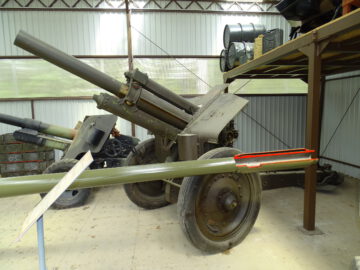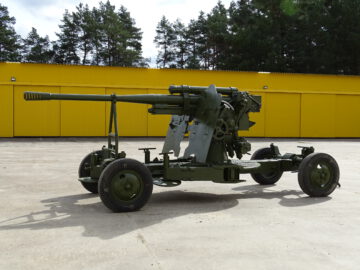

The gun was designed for direct anti-aircraft cover of troops, command posts, airfields, and other facilities. It could effectively engage air targets flying at altitudes of up to 3 km and distances of up to 4 km, as well as vehicles, including lightly armored ones.
It was equipped with an AZP-31-1 fire-control calculator, facilitating guidance when firing at fast-flying targets.
After the end of World War II, the Polish Army possessed 287 guns of this type, but most were worn out and were stored in equipment depots and military reserves. After post-war reductions, units possessed only 40 of them. This situation persisted until the end of the 1940s. The first steps to improve the situation were the production of spare parts and repair kits for 37 mm anti-aircraft guns. This task was assigned to the Southern Works in Stalowa Wola and the State Armament Works in Rzeszów. Between 1942 and 1952, 48 pieces were delivered from the USSR, and licensed serial production began at the Mechanical Works in Tarnów under the codename “product S-11.” This ensured continuous and substantial supplies of this type of gun to the army, in response to the dynamic expansion of the Polish Army (the growing conflict between the superpowers and the Korean War). By 1956, there were nearly 700 of them in the anti-aircraft artillery units of the Land Forces and the Air Forces and Anti-Aircraft Defense Forces. From the late 1950s, due to the introduction of new 57 mm S-60 guns and a general downsizing of the army, a gradual withdrawal of the guns dating back to World War II began. The introduction of anti-aircraft missile systems also accelerated this process. By 1965, they were completely gone from the air defense forces, and the land forces had only a few dozen pieces. The guns were placed in equipment depots, and their demise seemed imminent. However, the situation soon changed; 1967 and the Six-Day War brought a reassessment of the role of small-caliber, rapid-fire barrel anti-aircraft artillery. The excessive reliance on modern missile weapons guided by radar stations was tested by Israel, whose aircraft attacked Arab military positions at very low altitudes (below radar detection and missile deployment altitudes) and destroyed radar stations, rendering missile assets “blind” and defenseless.
The Polish Army also learned its lesson from this conflict. The formation of protective anti-aircraft batteries to defend airports, command posts, missile battalion firing positions, and radar stations began at a rapid pace. Between 1967 and 1980, a total of 85 anti-aircraft artillery batteries with 37 mm and 57 mm guns were formed, most of them with the now-reviving “37” anti-aircraft artillery (in 1981, the Polish Army still had 801 pieces in its inventory, and 10 years later, only about 400 in land forces). The final phaseout of service occurred only in the second half of the 1990s!
Basic specifications:
Combat weight: 2.1 t
Crew: 8 soldiers
Transition from marching to combat position: 25-30 seconds
Angle of fire: vertically from -5 to + 85 degrees; horizontally: 360 degrees
Towing speed: up to 60 km/h
Rate of fire: up to 160-180 rounds/min.
Ammunition: high-explosive tracer and armor-piercing tracer
Muzzle velocity: 870-880 m/s