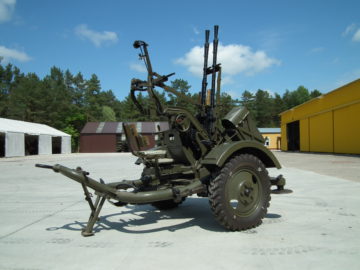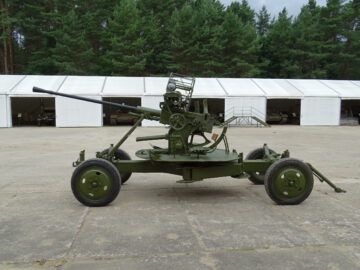

The SA/S-75 family of surface-to-air missile systems (designated “SA-2 Guideline” by NATO) was, for decades, the most widely used and most numerous system of its class in the world. Its emergence in the late 1950s transformed the nature of aerial warfare, and the shootdowns achieved by these systems are among the most famous in history—even to those with only a casual interest in the military history of the 20th century. They saw combat use in the USSR, various Middle Eastern conflicts, the Vietnam War, and over Cuba and China, among other locations. The origins of the Dvina system date back to the 1950s, when a decision was made to develop a mobile, more affordable, and lighter alternative to the stationary S-25 and S-50 systems used to defend Moscow and Leningrad. This effort resulted in the creation of the SA-75 Dvina anti-aircraft missile system. A firing battery consisted of six SM-63 single-rail launchers, each equipped with a two-stage V-750 (1D) missile. These were arranged in a circle, 50–75 meters away from the RSNA-75M fire-control radar station—which, in its final ‘M’ configuration, comprised four towed cabins: the PA (transmitter-receiver cabin with the antenna array), the UA (command and launch control cabin), the AA (computing/calculation cabin), and the RA/RMA (distribution and processing cabin, housing power generators). An early-warning radar post, featuring a P-12 radar and a PRW height-finding radar, was positioned approximately 300 meters away. It was with the SA-75 Dvina system that, on May 1, 1960, the Soviets shot down an American high-altitude U-2 spy plane—piloted by Francis Gary Powers—over Sverdlovsk. A second casualty was a Soviet MiG-19 fighter, which had also attempted to intercept and bring down the intruder. The decision to introduce anti-aircraft missile systems in Poland was made in 1959, in accordance with a directive from the Minister of National Defense, which stated: “To strengthen the anti-aircraft defense of the country, missile weaponry is to be introduced into the equipment of the Polish Armed Forces.” That same year, the first two SA-75 systems were delivered from the USSR. Within just a few years, approximately 80% of units transitioned from gun-based artillery to missile systems, and a comprehensive national air defense network was established—focused primarily on the areas around Warsaw, Silesia, and the Baltic coast—comprising over 30 firing and technical squadrons organized into divisions, brigades, and regiments of the National Air Defense Forces (OPK). One of these was the 25th Missile Squadron of the National Air Defense Forces (Military Unit 1068) in Dąbrówka. In 1963, a decision was made to introduce the more advanced S-75M Volkhov missile systems, which offered superior performance and partially replaced the older Dvina systems (including those in Dąbrówka). The SA-75 and S-75 systems operated by these missile squadrons were stationed at permanent, secret bases. All unit deployment sites followed a very similar layout, based on a standard plan and adapted only to local terrain conditions. The firing position of an S-75M Volkhov surface-to-air missile battalion consisted of several components. The first component was the radar and launch battery, which included a command and missile-guidance bunker—featuring shelters for command and guidance cabins and the antenna mast of the SNR-75W station—as well as six launch positions for SM-90 missile launchers, protected by earthen berms. It also housed an early-detection site equipped with a P-18 radar and a PRW-13 height-finder, along with shelters and sheds for ZiL-157 transport-loader vehicles and bunkers or shelters for launch crews. Next was the technical battery, containing storage facilities for ready-to-use missiles, infrastructure for the storage and distribution of rocket fuel, oxidizer, and compressed air, as well as areas for the assembly and arming of missiles. Finally, there was the barracks area, which housed communication and command facilities, a mess hall, a recreation room, a guardhouse, a boiler room, warehouses, a technical inspection point, a fire station, and garages for the unit’s vehicles. Ultimately, the S-75M Volkhov anti-aircraft missile systems were withdrawn from service with the Polish Armed Forces in 2001, after nearly 40 years of operation, and most of the units that employed them were disbanded. Only a few survived, having been re-equipped with other systems, such as the S-125 Neva.
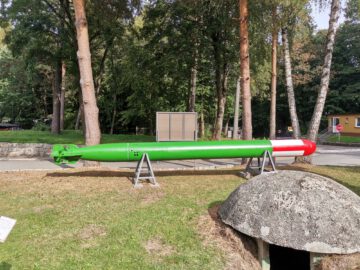
In the collection of the GRYF Museum of Military Technology, we hold a complete SM-63 launcher, along with a V-750 missile from the SA-75 Dvina system, as well as a section of a V-755 missile from the S-75M Volkhov system (comprising two segments): 1, containing components of the radio-proximity fuze and fitted with destabilizers; and 2, which housed the 198 kg high-explosive fragmentation warhead).
Technical specifications for the SA-75 Dvina (W-750 missile):
Launcher: SM-63
Rotation sector: 360°
Guide elevation angle: 10–65°
Launcher weight in transport configuration: 12 t
Launcher weight in combat configuration: 8.4 t
Launcher control: remote, electro-hydraulic (manual in case of emergency)
Missile: W-750
Guidance method: command guidance, with radar tracking of both the missile and the target
Fuze: radar-based proximity fuze with a self-destruct mechanism
Length: 10.73 m
Missile weight: 2163 kg
Booster engine thrust: 27,000–50,000 kgf
Booster engine burn time: up to 5 sec / 4 sec
Sustainer engine thrust: 2650 kgf
Sustainer engine burn time: up to 25 sec
Range: 8 to 29 km
Engagement altitude: 3 to 22 km
Maximum target flight speed: 1500 km/h
Technical specifications for the S-75M Volkhov (W-755 missile):
Launcher: SM-90
Rotation sector: 360° deg.
Launcher elevation angle: 10–75 deg.
Launcher weight in traveling configuration: 14.2 t
Launcher weight in combat configuration: 11.1 t
Launcher control: remote, electro-hydraulic (manual in case of emergency)
Missile: V-755
Guidance method: command guidance, with radar tracking of both the missile and the target
Fuze: radar proximity fuze with a self-destruct mechanism
Length: 10.78 m
Missile weight: 2397 kg
Booster engine thrust: 35,000–58,000 kgf
Booster engine burn time: 4 sec.
Sustainer engine thrust: 2000–3500 kgf
Sustainer engine burn time: 48–58 sec.
Range: 7 to 43/56 km
Engagement altitude: 1 to 30 km
Maximum target flight speed: 2300 km/h