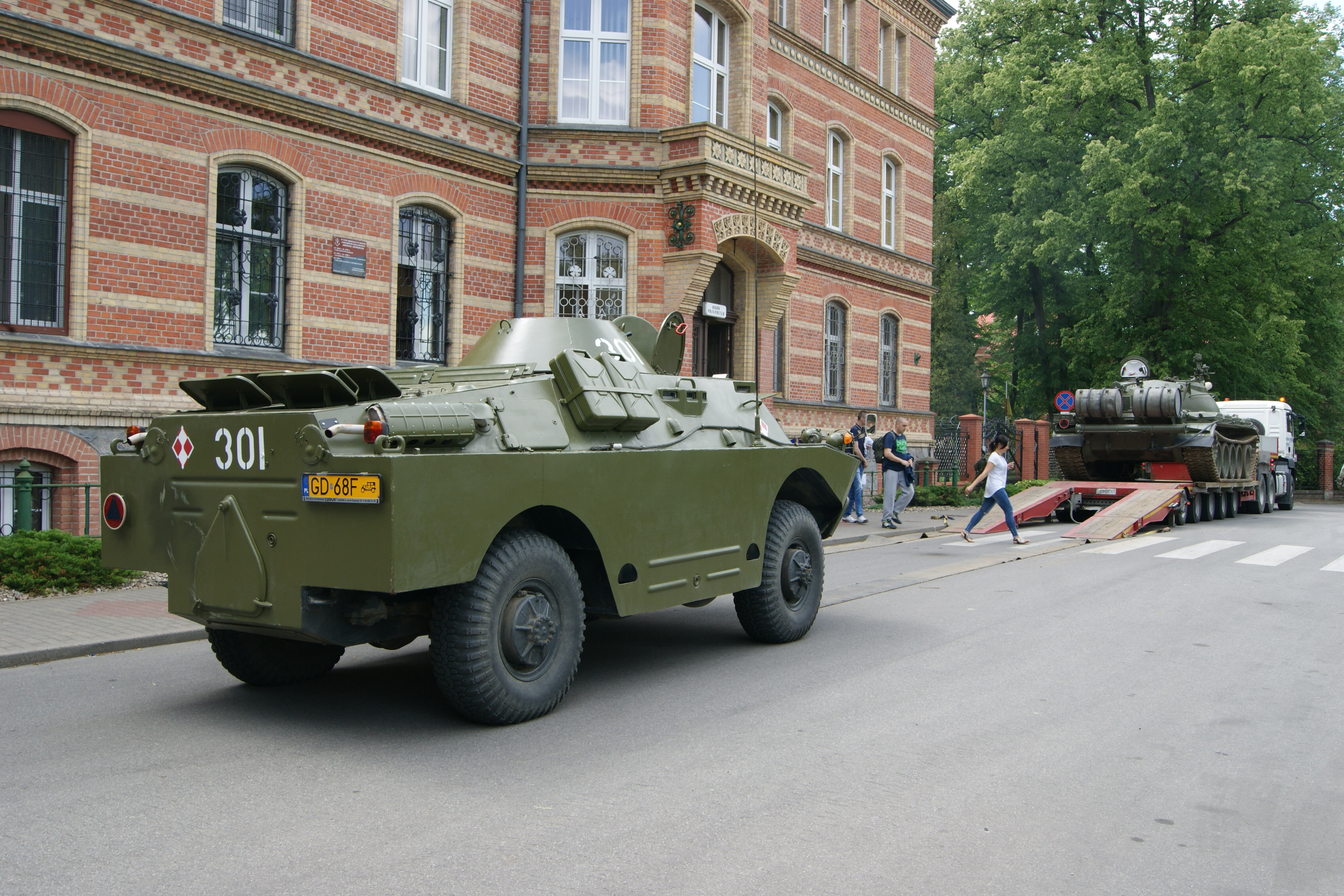

The BRDM-2 (Bronirovannaya Razvedyvatelno-Dozornaya Mashina – “armored reconnaissance and patrol vehicle”) is a Russian 4×4 armored vehicle. It was developed in the late 1950s and early 1960s at the Dedkov Design Bureau. The design team was led by V. K. Rubtsov. The vehicle was officially unveiled in 1966. The BRDM-2 armored vehicle replaced the BRDM-1 in the Soviet Army.
The hull of the BRDM-2 is divided into three compartments: the forward control compartment, the central combat compartment (featuring a rotating turret), and the rear engine compartment, which is separated from the rest of the vehicle by an armored bulkhead. The vehicle’s armor, constructed from welded steel plates, provides protection only against small-caliber projectiles.
The crew of the BRDM-2 consists of four personnel: a commander, a driver, a gunner, and a scout. The driver sits on the left side of the control compartment, with the commander positioned next to him. Both crew members have circular hatches above their heads, which serve as the vehicle’s only entry and exit points. They observe the terrain ahead through periscopes arranged around the hatches or through two large armored vision blocks, which can be covered by metal plates in high-threat environments. Additional periscopes are also located along the central sections of the side walls.
The armament is housed in a BPU-1 rotating turret. It contains two coaxial machine guns: a 14.5mm KPVT (with a supply of 500 rounds) and a 7.62mm PKT (with a supply of 2,000 rounds). The gunner engaged targets using a PP 61 A optical sight. The turret traverse system is manually operated, with a horizontal traverse range of 360° and a vertical elevation range from -4° to +30°. Additionally, the crew has the capability to fire weapons from within the vehicle; the side walls are equipped with one firing port and three periscopes each for observation.
The vehicle is powered by a liquid-cooled, V-8 gasoline engine—the GAZ 41—which produces 102 kW (140 hp) at 3,400 rpm. The drivetrain includes a mechanical, dry, single-plate clutch; a transmission (with four forward gears and one reverse gear, where the 3rd and 4th gears are synchronized); a two-speed reduction gearbox; a transfer case; and self-locking axle differentials. Air intakes for the engine and maintenance access hatches are located on the roof of the engine compartment.
The running gear of the BRDM-2 features a highly interesting design. The armored vehicle utilizes a 4×4 drivetrain. Its suspension consists of longitudinally mounted leaf springs paired with telescopic hydraulic shock absorbers. It is fitted with 13.00×18 tires. Furthermore, to facilitate traversal of extremely difficult terrain, the vehicle is equipped with four auxiliary wheels. These wheels are mounted on swing arms and, during routine operation, are stowed beneath the side panels of the hull, between the two main axles. When navigating challenging terrain, the driver can lower them using a mechanical system. These auxiliary wheels are driven via a chain drive. The steering system is of the worm-gear type—lacking power assistance—and acts upon the front axle wheels. The vehicle employs hydraulic drum brakes and a central tire inflation system.
The BRDM-2 armored vehicle is amphibious. Propulsion in water is provided by a water jet (propeller unit) located at the rear of the hull, along the vehicle’s centerline. Steering while afloat is achieved via rudders positioned directly behind the water jet. Before entering the water, a trim vane (wave deflector) located at the front of the hull is raised.
As standard, the BRDM-2 is equipped with an extensive suite of navigation systems (the TNA-2 unit), communication equipment, and contamination detection gear (including a DP-3B radiometer and a PChR chemical reconnaissance set). The vehicle is also fitted with a winch.
The BRDM-2 served as the basis for a number of specialized vehicles:
BRDM-2U: a command and staff vehicle, featuring an enlarged hull and lacking both a turret and armament.
BRDM-2 RS: a chemical/radiological reconnaissance vehicle.
BRDM-2 as a carrier for the 9K35 Strela-10 anti-aircraft missile system.
BRDM-2 as a carrier for the 9M113 Konkurs anti-tank missile system.
The BRDM-2 was used as a platform for various anti-tank guided missile (ATGM) systems—including the 9M14 Malyutka, 9M17 Falanga, 9M17P Skorpion, and 9M113 Konkurs—as well as the 9K35M3 Strela-10M3 anti-aircraft missile system.
The BRDM-2 entered the arsenals of many nations, including: Albania, Algeria, Angola, Benin, Bulgaria, the Central African Republic, Chad, the Congo, Egypt, Equatorial Guinea, Ethiopia, the German Democratic Republic (GDR), Guinea, Iraq, Israel, Djibouti, Libya, Madagascar, Malawi, Mali, Mauritania, Mongolia, Morocco, Mozambique, Nicaragua, Peru, Poland, Romania, Somalia, Sudan, Syria, Tanzania, Uganda, Vietnam, Yemen, Yugoslavia, Zambia, Zimbabwe, Cuba, São Tomé and Príncipe, Cape Verde, and Hungary. Within the Polish Armed Forces, the BRDM-2 replaced the BRDM-1 and FUG vehicles. It is used as a standard vehicle for reconnaissance units and by the command elements of units from other branches of the armed forces. A highly successful upgrade of the BRDM—designated the BRDM-2B—was developed at the Military Mechanical Works (Wojskowe Zakłady Mechaniczne) in Siemianowice Śląskie.
TECHNICAL DATA: BRDM-2
Country: Russia
Crew: 4
Drive configuration: 4×4
Combat weight (kg): 7,000
Power-to-weight ratio (kW/t): 14.7
Length (mm): 5,750
Width (mm): 2,350
Height (mm): 2,310
Ground clearance (mm): 430
Track (mm): 1,840
Wheelbase (mm): 3,100
Speed (km/h): 100
Fuel capacity (liters): 290
Range (km): 750
Fording (m): Amphibious (capable of swimming)
Engine: GAZ-41, eight-cylinder, gasoline-powered, liquid-cooled; output of 102 kW (140 hp) at 3,400 rpm.
Transmission: Manual, four forward gears, one reverse gear.
Armament (ammunition): 14.5 mm KPVT heavy machine gun (500 rounds), 7.62 mm PKT machine gun (2,000 rounds).